EN
EN


Industrial Sectional Doors: Core Applications and Advantages in Modern Industrial Settings
Executive Summary
The Industrial Sectional Door, often referred to as an industrial overhead door or sectional overhead door, is a standard fixture in modern logistics centers, manufacturing plants, and specialized garages. Due to its vertical lift opening method, exceptional insulation performance (polyurethane foam filling), and high wind resistance, it has become the preferred solution for optimizing industrial building space and energy efficiency. This article provides an in-depth analysis of its application value and technical advantages across various industrial scenarios.
1. Why Are Sectional Doors Preferred in Industrial Settings?
Compared to traditional roller shutters or swing doors, the sectional door addresses three core pain points in the industrial environment:
Maximized Space Utilization: The door body slides vertically upwards along the wall tracks, not occupying space on either side of the door opening or the internal depth. This makes it a perfect fit for compact warehousing environments.
Superior Insulation and Energy Saving: The door panels typically consist of a double layer of color-coated steel sheets filled with high-density polyurethane (PU) foam (40mm-50mm thick), effectively isolating indoor and outdoor temperature differences and reducing HVAC energy consumption.
High Wind Resistance and Security: The robust door panel structure, combined with a torsion spring balancing system, enables it to resist strong winds (up to Class 10 or more) and provides enhanced anti-theft capabilities.
2. In-Depth Analysis of Core Application Scenarios
2.1 Loading Docks
This is the most typical application for industrial sectional doors. In logistics centers, the overhead door is usually used in conjunction with a Dock Shelter and a Dock Leveler to form a complete loading and unloading system.
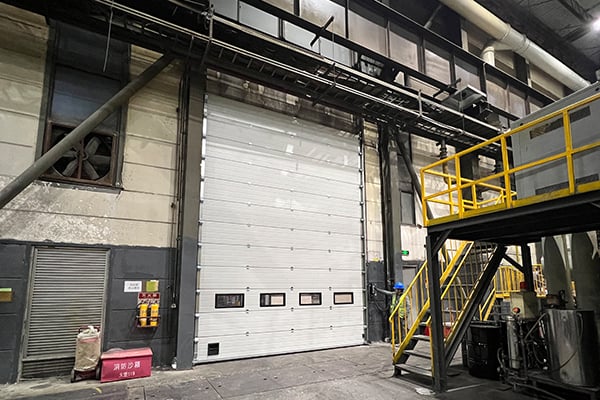
Application Characteristics: Requires high-frequency opening/closing and observation windows to view truck docking status.
2.2 Cold Chain Warehouses & Controlled Environment Workshops
Temperature control is crucial for food processing, pharmaceutical manufacturing, or electronic chip factories.
Application Characteristics: Uses thicker door panels (e.g., 50mm or 80mm) and is equipped with more stringent bottom and side EPDM (Ethylene Propylene Diene Monomer) weather seals to prevent cold air loss.
Technical Metric: The thermal conductivity coefficient is typically lower than $0.045 W/(m \cdot K)$.
2.3 Automotive Industry & 4S Dealerships
At the end of an automotive production line or in a 4S dealership service bay, the overhead door serves as both a passage and a display window.
Application Characteristics: Often uses a Full Vision Door, where the door panels consist of an aluminum alloy frame and transparent Polycarbonate (PC) sheets or tempered glass, offering excellent natural lighting and aesthetics.
2.4 Heavy Machinery Plants
For workshops housing overhead cranes, the door openings are often very tall.
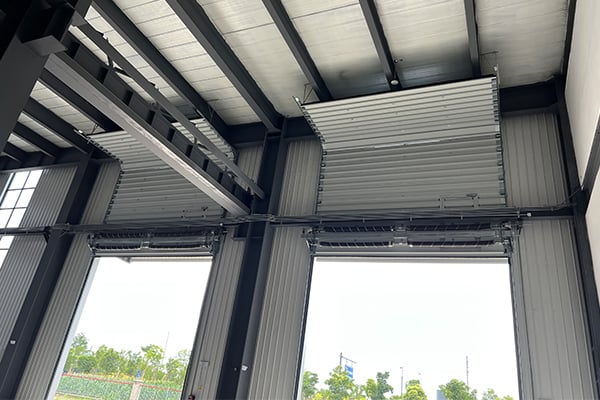
Application Characteristics: Utilizes a High Lift or Vertical Lift track system, allowing the door, when open, to sit tightly against the ceiling or rise vertically, keeping it clear of the crane rails below.
3. Technical Specifications Comparison Table
|
Core Parameter |
Description/Standard Value |
Advantage Explanation |
|
Panel Material |
Double-layer Color-Coated Steel + PU Foam |
High strength, excellent thermal insulation performance |
|
Panel Thickness |
40mm / 50mm / 80mm |
Thicker panels result in a higher R-value (insulation factor) |
|
Balancing System |
Torsion Spring Balancing System |
Assists motor lift, extends motor life, light effort for manual opening |
|
Wind Resistance Rating |
≤700N/m2 (Approx. Class 10-12 Wind) |
Suitable for coastal typhoon areas or open factory sites |
|
Lift Type |
Standard Lift, High Lift, Vertical Lift |
Flexible adaptation to different building heights and internal structures |
|
Safety Devices |
Torsion Spring Break Safety, Cable Break Safety, Safety Airbag |
Comprehensive protection for personnel and cargo |
4. Frequently Asked Questions (FAQ)
Q: What is the difference between a sectional door and a high-speed roll-up door?
A: The sectional door focuses on security, insulation, and wind resistance, with a relatively slow opening speed (approx. $0.2-0.3 m/s$), making it suitable as an exterior door. The high-speed roll-up door focuses on fast and frequent opening/closing ($0.8-2.0 m/s$) to isolate dust and temperature, making it suitable as an interior door or a high-traffic passage. They are often used in combination ("airlock" or "interlocking double door" system).
Q: Can a sectional door be fitted with a pedestrian pass door (wicket door)?
A: Yes. If the door width permits, a "door-in-door" can be installed, allowing personnel to enter and exit without opening the entire main door, thereby further saving energy.
Q: What if there is a power outage?
A: All industrial sectional doors are equipped with a torsion spring balancing system and a manual chain hoist/clutch device. Even during a power outage, a single person can easily open the large door manually by pulling the chain.