EN
EN


The New Industrial Standard: How Sectional PVC High-Speed Doors Boost Efficiency and Cut Maintenance Costs
The Sectional PVC High-Speed Door (also known as a Stacking or Fold-up High-Speed Door) is a critical asset for modern industrial facilities. Unlike traditional one-piece curtain doors, it utilizes aluminum wind ribs to connect segmented PVC curtains. This modular design delivers superior wind resistance (up to Beaufort Scale 10) and significantly reduces maintenance costs—allowing for single-piece curtain replacement rather than replacing the entire door curtain.
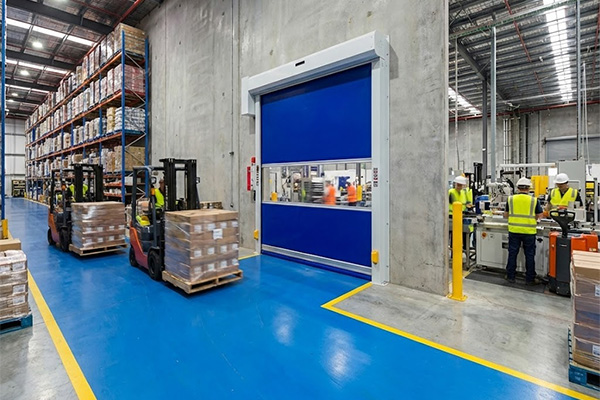
1. What is a Sectional PVC High-Speed Door?
A Sectional PVC High-Speed Door is a rapid-action door designed for high-frequency logistics channels. Its defining feature is its modular curtain structure:
Structure: The door curtain is not a single continuous sheet. Instead, it consists of multiple PVC panels joined together by high-strength aluminum alloy wind ribs.
Operation: Typically uses a "stacking" or "folding" lifting mechanism with straps, achieving opening speeds of 0.8m/s to 1.2m/s.
Core Value: It specifically addresses the two major pain points of traditional fast doors: Weak Wind Resistance and High Repair Costs.
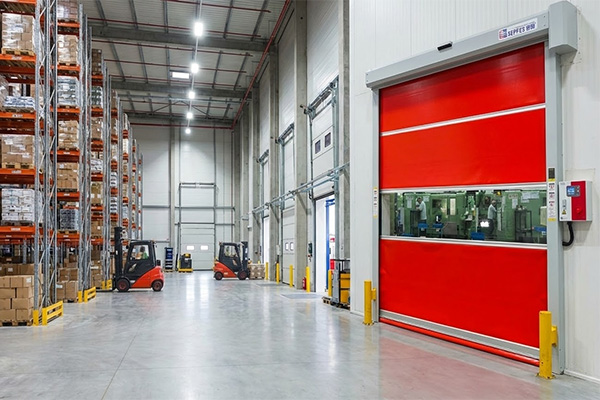
2. Why Choose the "Sectional" Design for Industry?
For heavy industry, logistics warehousing, and large exterior openings, the sectional design offers decisive advantages:
A. Lowest Maintenance & Replacement Costs
This is the strongest selling point for facility managers.
The Problem: With traditional integrated/zipper doors, if a forklift accidentally tears the curtain, the entire sheet often needs replacement, leading to high costs and downtime.
The Solution: The sectional door curtain is independent. If a section is damaged, you simply remove the aluminum rib and replace only the damaged PVC strip.
The Impact: Maintenance material costs can be reduced by approximately 60%-80%.
B. Superior Wind Resistance
Mechanism: The aluminum wind ribs run horizontally across the entire width of the door, acting as a sturdy skeleton.
Application: Ideal for exterior mounting, coastal factories, or logistics channels with high wind pressure.
Rating: Capable of withstanding Beaufort Scale 8-10 (and higher for specific reinforced models), far exceeding standard zipper-type doors.
3. Key Application Scenarios
1. Logistics Loading Docks
The critical link between the indoor warehouse and outdoor trucks. Sectional doors effectively block strong outdoor winds. When paired with a Dock Seal, they create a sealed environment to maintain indoor temperatures.
2. High-Traffic Forklift Lanes
Utilizing Geomagnetic (Loop) Sensors or Radar Sensors, the door opens rapidly (fully open in 0.6–1.5 seconds). Forklifts can pass through without decelerating, significantly increasing logistics throughput.
3. Large-Span Openings
For openings wider than 5 meters (or even up to 10+ meters), standard rolling doors are prone to derailment. The Stacking/Fold-up structure relies on heavy-duty lifting straps, ensuring stable operation even for oversized dimensions.
4. Technical Specifications (Data Sheet)
|
Specification |
Standard Value |
Note |
|
Opening Speed |
0.8 - 1.2 m/s |
Adjustable; Servo systems can reach 1.8+ m/s |
|
Curtain Material |
0.8mm - 1.2mm PVC |
High-strength polyester fiber, tear-resistant |
|
Wind Resistance |
3.5kPa (Beaufort 11) |
Reinforced by Aluminum Wind Ribs |
|
Motor System |
Servo Motor |
Recommended for precision and low failure rate |
|
Safety Devices |
Photocell / Safety Edge |
Auto-rebound upon impact to protect personnel |
|
Life Cycle |
> 1,000,000 Cycles |
Designed for high-frequency use |
5. Frequently Asked Questions (FAQ)
Q: What is the difference between a Sectional High-Speed Door and a Zipper High-Speed Door?
A: Zipper doors (Self-repairing) offer better airtightness and are ideal for indoor cleanrooms. Sectional doors (Wind-bar type) offer superior structural strength and wind resistance, making them the better choice for large exterior openings and harsh weather conditions.
Q: How do I repair a Sectional High-Speed Door if it is hit by a forklift?
A: You do not need to replace the whole door. Simply unscrew the aluminum wind bars above and below the damaged area, slide out the broken PVC panel, insert a new one, and retighten. A skilled technician can finish this in 15-20 minutes.
Q: Can this door be used in cold storage?
A: Standard PVC can harden in extreme cold. For cold storage, request "Low-Temperature Resistant PVC" material, which remains flexible down to -30°C.