EN
EN

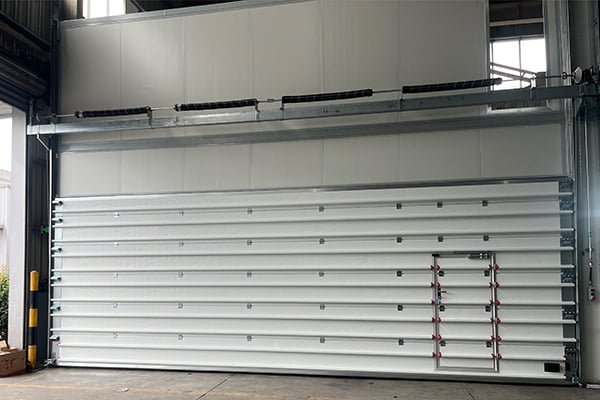
Warehouses, distribution centers, and factories need reliable indoor conditions. Products must remain safe, machines must work efficiently, and staff need comfortable workplaces. Any rise and fall in temperature, changes in humidity or unwanted air currents can quickly put both your goods and machinery at risk.
A high employee turnover due to uncomfortable working environments can result in higher costs for recruiting, training and sick leave. So a well insulated outer wall and entrance to prevent the outside entering the building interior is crucial. The weakest link in a warehouse building often proves to be its loading bay door. The insulated sectional overhead door provides a breakthrough in protecting its indoor environment. We develop technologically advanced insulated doors with maximum sealing performance, helping your business maintain stable indoor climates in both buildings, warehousing, and factories.
The Science of Thermal Barrier Construction
The basis for a reliable environmental management strategy lies in the physical makeup of the door. What makes up a "real" insulated sectional overhead door is that it uses an interlocking of materials which prevents thermal transfer. The exterior and interior steel skins of the door are typically formed from thick galvanized steel with an insulating foam core in between. The core is filled with a dense foam product that is injected under pressure. This foam, polyurethane, expands and adheres directly to the steel skins of the door, foam core helps reduce conductive heat transfer and air movement within the panel. A quality insulated overhead sectional door will achieve a high R-value, the rating that determines the door's overall effectiveness as an insulator. The higher the R-value the better it keeps warm air in during the winter, and cool air in and summer sun heat out during the summer. Seppes Door employs non-ozone-depleting, environmentally safe CFC-free polyurethane in our insulated doors that will continue to serve decades without thermal breakdown.
Precision Sealing Against Air and Moisture Infiltration
If you put R-16 value, or higher panels into a doorway with gaps, they won’t do much. One of the main factors of a poorly temperature controlled building is air infiltration through poorly sealed gaps in the opening of a door; air is getting in or it’s getting out! The Seppes Insulated Sectional Overhead Door uses the entire building’s door perimeter for insulation with a full system of weather-seals. Panels interlocking joints provide a tightly fitted seal from each other. The entire door opening has weather seals composed of hardy elastomeric such as EPDM to assure that you achieve maximum air seal to the sides and the overhead header and to the floor. Special bottom seal that works against floor irregularities and even a slight settling of the building is important. The bottom of the Seppes door features EPDM rubber. That’s built to yield and assure a strong seal every time.
Impact on Energy Efficiency and Operational Costs
A facility that depends on the cooling of the building (air conditioning) or warming of the facility (heating) must always try to keep the temperature below some optimum value. Any increase of the facility’s temperature will drive the cooling of the HVAC equipment so much harder and lead to an increased cost of operation and increased depreciation of the HVAC equipment. With an insulated sectional overhead door, the amount of heat load which enters or leaves the building, will be reduced. This helps to lessen the cycles needed for the cooling or heating of the facility, the impact is much larger with the opening and closing of doors from the many large facilities that will have a lot of them and many dock doors. Savings from an insulated door can be so substantial that many facilities see the door pay back for its initial costs in just few years. Seppes designs its insulated sectional doors focusing on Energy Efficiency and offer insulation, even thermal break on its hardware and/or sight windows filled with insulating glass.
Protection for Temperature-Sensitive Inventory and Equipment
Beyond cost control – protect products and assets “While operational expenses are obviously a significant concern when looking to secure your premises, there are also operational advantages to an insulated door. Temperature and humidity are critical in many industrial environments for ensuring products are not compromised; anything from electronics, pharmaceuticals, food items and raw materials can deteriorate if the environment is not kept at optimal levels. If temperature fluctuates dramatically, for example from warm to cold or vice-versa, products can lose shelf life and in worst-case scenarios become spoiled entirely leading to massive write-offs. Similarly the thermal expansion and contraction of machinery could lead to costly breakdowns.
The insulated sectional overhead door is a high barrier against this occurring and will allow businesses, that need to keep products cool for instance or where there are extreme temperature fluctuations, a stable environment to keep inventory at safe levels and machinery in working order. Seppes Door provides bespoke doors that will meet cold storage applications and any industrial settings that require climate control.